Afghanistan
AFG HNRP 2026 Summary
Overview
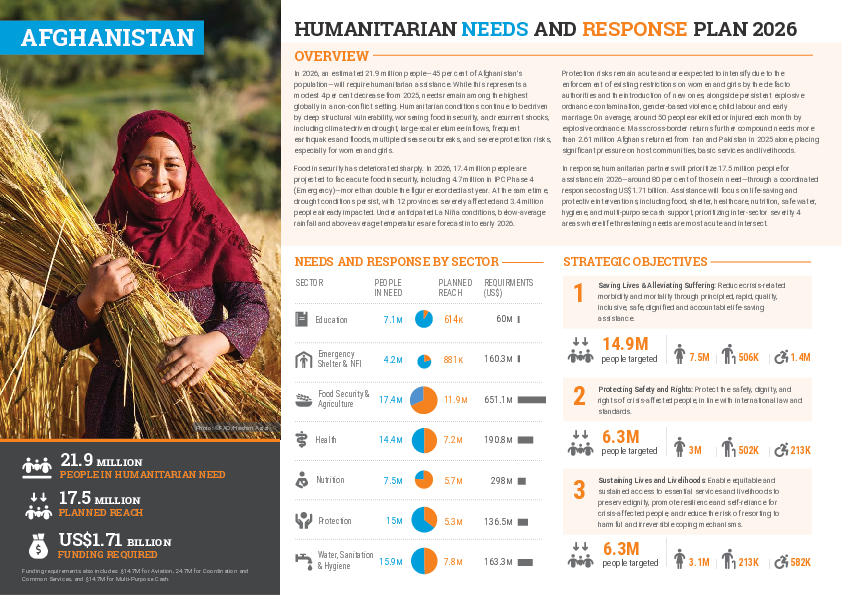
In 2026, an estimated 21.9 million people—45 per cent of Afghanistan’s population—will require humanitarian assistance. While this represents a modest 4 per cent decrease from 2025, needs remain among the highest globally in a non-conflict setting. Humanitarian conditions continue to be driven by deep structural vulnerability, worsening food insecurity, and recurrent shocks, including climate-driven drought, large-scale returnee inflows, frequent earthquakes and floods, multiple disease outbreaks, and severe protection risks, especially for women and girls.
Food insecurity has deteriorated sharply. In 2026, 17.4 million people are projected to face acute food insecurity, including 4.7 million in IPC Phase 4 (Emergency)—more than double the figure recorded last year. At the same time, drought conditions persist, with 12 provinces severely affected and 3.4 million people already impacted. Under anticipated La Niña conditions, below-average rainfall and above-average temperatures are forecast into early 2026.
Protection risks remain acute and are expected to intensify due to the enforcement of existing restrictions on women and girls by the de facto authorities and the introduction of new ones, alongside persistent explosive ordnance contamination, gender-based violence, child labour and early marriage. On average, around 50 people are killed or injured each month by explosive ordnance. Mass cross-border returns further compound needs: more than 2.61 million Afghans returned from Iran and Pakistan in 2025 alone, placing significant pressure on host communities, basic services and livelihoods.
In response, humanitarian partners will prioritize 17.5 million people for assistance in 2026—around 80 per cent of those in need—through a coordinated response costing US$1.71 billion. Assistance will focus on life-saving and protective interventions, including food, shelter, healthcare, nutrition, safe water, hygiene, and multi-purpose cash support, prioritizing inter-sector severity 4 areas where life-threatening needs are most acute and intersect.